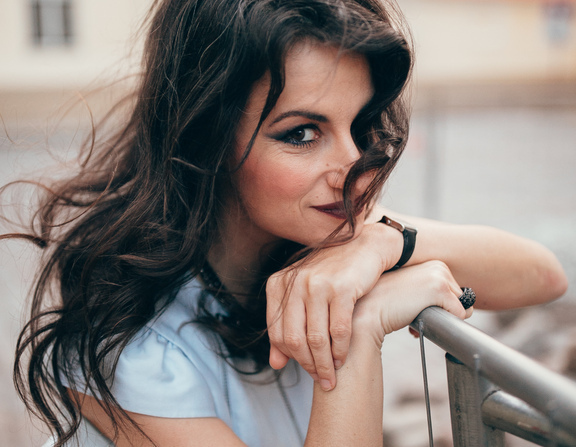
Foto: Dmitri Kotjuh.
Yolanda Castaño is one of the most important contemporary Spanish poets, the internationally best-known contemporary Galician poet, as well as an essayist, translator, artist, curator, and organizer of poetry festivals. On the occasion of her guest appearance at Goran's Spring/Goranovo proljeće, Ivana Dražić spoke with this multifaceted poet.
As part of Goran's Spring, seven of your poems have been translated from Galician. Could you tell us something about the context of these poems, how they came about? And why specifically these seven poems?
These poems belong to my last two collections of poems. The first of them was the winner of the Spanish National Award for Poetry 2023, which for the fourth time in a hundred years history went to a work originally written in Galician. It is a collection that revolves around the idea of family projected into the past, present and future, always from a critical perspective that seeks to question traditional roles.
The second one has just been published this month, still only in Galician, although it will soon be published in a bilingual Galician-Spanish edition for the rest of Spain and Latin America. This very recent book deals poetically (avoiding a social realist style) with economic tyrannies and the servitudes of work. It talks about indebtedness, hyperproductivity, self-exploitation; about the crushing capitalist machinery, so perverse that it is capable of making us both victim and party, burdening us with all the unexpected extra guilt and frustration
How would you describe your poetic preoccupations in brief? If it’s even possible to “briefly describe” your incredibly rich poetic oeuvre...
Always starting from the honesty with which I aspire to express myself in my poetic work, which makes me incapable of dealing with that which does not touch, involve or move me deeply, each vital stage directs my curiosity and my interest towards a theme or some contents about which I question myself until I want to know more. In this sense, my latest concerns point to what I have just mentioned in the previous question. To the dystopian turbo-capitalist scenario and what it makes of us. It was a challenge for me to talk about money from a literary genre where it is not so much 'photogenic' as uncomfortable, ignoble. Those muds are always stimulating for me and for my creative practice. But the fact is that the economic mandate is, after all, a mandate of misery, and it is time for the poetic gaze to also analyze this issue which, in reality, is capable of affecting us emotionally much more than we are willing to admit.
You write in Galician, which, as a reminder to readers, is an official language in Galicia, Spain, alongside Spanish. Could you tell us something about the decision to write in this “small” language? I assume this is (also) a political decision?
Although Galician is a language as old as Spanish (with written traces as early as the twelfth century) and that through the common root with Portuguese connects us with a huge pontial linguistic world (from Brazil to Angola through Mozambique or Macau) it is true that it is a language with a sociolinguistic status below Spanish.
However, for me there is a double or triple coherence in writing from a geographical periphery such as Galicia within the Spanish state, doing so from the marked genre that (as opposed to the unmarked) is still today being a woman, cultivating a literary genre on the margins of the market and doing so, moreover, in a language that is not only a minority but 'minoritized' language. After all, poetry itself will never be a language of power. On the contrary, poetry is the alternative language to the discourse of power. Since we understand reality in such a logocentric way, if we try new ways of saying reality, we will also be trying new ways of interpreting the world, new ways of understanding and thus also of living life. Hopefully, more hospitable ways for everyone.
In that sense, yes, of course, writing in a language far from power (political, economic, etc.) is a political positioning, very much in line with that which poetry itself demonstrates‘per se’.
You have published seven books of poetry, and in interviews, you stress out that you have been writing your whole life, since childhood. How has your poetry evolved over time? How do you view your early poetic steps from today's perspective?
Returning to the frankness I mentioned earlier as a starting point, as I mentioned, the thematic evolution of my poetry has been running parallel to my own personal development. In my youth, topics such as the body, carnality or erotic experience appeared because they were precisely what I was discovering at that vital stage. I knew so little that I was just beginning to learn about my own body and could only manage to speak knowledgeably about something so close to me. Later I began to ask myself who I was and I approached issues of personal identity, then all the problems associated with the representation of that identity (crossed by a gender perspective). Somewhat later I began to separate my gaze and turn it towards the other, dealing with language as that bridge that connects us with others, although its passage is not always straight or free of obstacles. In recent times I have dealt, as I was saying, with contents more associated to the idea in constant and open transformation of the family and also to the economic system and its traps. With the passage of time, from the formal point of view, although the conceptual apparatus has not been simplified at all, I think that the formal one has been simplified a little. However, for me it is important to always keep searching in creative matters, not to find a formula that works and get stuck on it, so the experimental and nonconformist spirit does not lower its arms.
In preparing for this interview, I noticed that you quite openly speak about poetry as a profession that you make a living from. Besides that, your poems that are translated in Croatian have a strong social aspect: you address issues such as housing, loans, productivity, money in a very interesting and direct way. Why is it important for you to address these topics?
I have never believed that there are 'poetic' themes in themselves, but rather that what is poetic is the type of look we cast on them. Poetry is one more cognitive tool that the human being possesses; a complementary language to others (such as philosophy, science or technology, for example) when it comes to approaching and analyzing reality. Where other languages are not enough, when they are scarce or incomplete, poetry can be useful when it comes to providing new perspectives.
What we know is not only portrayed by what we reflect or investigate technically, but also by the impressions or emotions that it leaves us, sometimes much more serious or significant for the human being than other types of data. In that sense, I missed the contribution that poetic discourse (and moreover, from a more transcendent and less social-realistic style) could bring to the current panorama of voracious capitalism, productivity and exploitation. One of the most unavoidable tasks of poetry should be, in my view, to be somehow a witness of its time. So, how can we not get involved in dealing with these uncomfortable topics, but which, if we are honest, affect our generations so much in reality?
In your poetry, both the ones translated into Croatian and in general, you deal with feminist themes, gender role stereotypes, motherhood, physicality, etc. What do you think is the role of poetry in the wider feminist movement?
One of the fields in which feminism has achieved the most is the cultural field. In my country, statements with a macho bias are highly discredited. Much remains to be done, especially on issues such as equal pay, violence or social roles, but the symbolic field is also relevant in that it provides a basis on which to build either traditional roles, violence, stereotypes and inequality or greater equality.
Returning to my words about poetry as a tool for social transformation by changing modes of speech, I believe that literature (and music, film or the visual arts) can still have something to say. Imaginaries must change in order for behaviors to change as well.
You have won the most important Spanish awards for poetry – how much do such recognitions mean to you?
I will be frank and I will not deny its importance for someone who, like me, has made such a strong commitment to make poetry not an occupation for her free time, but a way of life. Let's say that the recognitions have been compensating for my renunciation of a life with some comforts and securities, since they help me to access more and better jobs, reading audiences or opportunities to broaden my creative experiences. They keep me constantly active, in touch with other poetic voices and creatively alert as well, which is a blessing for my own poetry.
I never thought that a girl from the northwest corner of Spain writing in a language of three million speakers could get there, but they also say that life is what happens while you were making other plans. There has been a lot of dedication and sacrifice, but after those 30 years without letting my guard down, now I see the fruits.
I find it very interesting how you concieve poetry in a multimedial way, combining it with music, visual arts, architecture, cooking (!), dance, etc. I think I’ve never seen poetry being paired with such a wide range of other arts (and crafts). Do you feel that poetry alone is, in some sense, “limiting” or „limited”, restricted? What does poetry gain from this connections?
I don't think it is limited in itself. Poetry is a very complete and totally autonomous language, which I love to read in intimacy. But, starting from that awareness, later on we can play, establish dialogues that can be very profitable expressively. Poetry can reach out to other expressive codes that make it emerge from its solitude or gain new audiences. In this way it can create hybrids that participate at the same time in poetry and other arts that help it to reach new and interesting fields. I like poetry to come out of its ivory tower, to go out into the streets and to contaminate itself with the world and with life, much more in contact with all areas of life, wherever people are.
I can’t help but ask how you combine poetry with cooking? I’ve been fascinated by this idea ever since I read your biography!
It would take too long to tell. It was a book in which I invited Galician authors not only to think of a recipe that represented them as writers (that represented their way of writing, their literature) and to write it not technically, but from a literary breath. In addition, I asked them to cook it in front of the cameras of a visual artist capable of finding the most artistic angles. In that work I also showed in how many aspects writing and cooking are similar as the creative processes they both are, and how the same person who cooks is the same person who writes, similar in many aspects.
You are a guest at Goran's Spring, a festival dedicated to “the idea of poetry as one of the forms of the struggle for personal and universal freedom.” How do you see the role of poetry in the fight for freedom?
In the same sense in which I have been exposing throughout this interview: to continue under the slabs of the ‘inherited truths’, the ‘unique truths’ and their unquestionable formulas, bind us to a way of understanding reality that is terribly emasculating, restrictive. The ‘unique truths’ and their unquestionable formulas bind us to a way of understanding reality that is terribly castrating and restricting. Perhaps new words cannot be invented, but by trying out new relationships between them we can pronounce new ways of understanding and living reality that free us from many enslavements.