
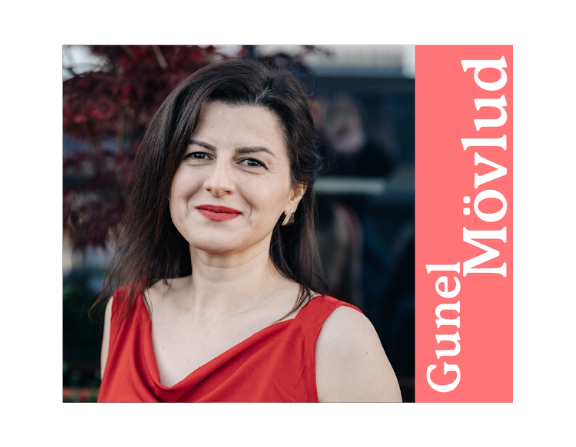
Foto: Mattis Kleeb.
Gunel Mövlud, whose poetry is featured in the anthology Dobro smo. A vi?, answered a few flash questions.
What does the term “migrant literature” mean to you?
To me, émigré literature signifies the unique novels penned by writers forced to live far from their homelands and separated from their loved ones. It means the many fine films adapted from the works of these expatriate authors. It encompasses texts—and memoirs—unlike any found elsewhere. For me, émigré literature means Nabokov, Bunin, Ummulbanu Asadullayeva, Limonov, and Dovlatov.
What do you think migrant writers bring to contemporary literature that would otherwise be missing?
At different times, various writers introduce distinct values, trends, literary realities, and unique qualities to literature. Yet, there is one constant in what they bring to the literary world: the anatomy of emigration. In my view, each writer reveals—through their texts—a new and perhaps previously unknown facet of emigration, once again introducing us to this painful process.
Why do you write?
I grew up in a poor family. In 1993, during the First Karabakh War between Azerbaijan and Armenia, I was forced to flee my native village as a refugee. I had to live in refugee camps for five years. Under those conditions, it was impossible to experience any form of entertainment or the pleasant aspects of life. As a child—and later as a teenager—my only refuge was found in books and novels. I was a child who literally lived inside the world of books. They helped me tune out the harsh realities of life—the poverty, the fear, and the lack of joy—and instead inhabit a colorful, joyful existence.
I eventually realized that literature was my sole sanctuary and my way of life.
What’s the best and the worst writing advice you’ve ever been given?
It was during the early years when my poems were being published. When my paternal grandmother found out, she insisted that I dedicate a poem to her. Because I loved her dearly, I did so, and the poem appeared in one of the literary newspapers. My mother, upon reading it, became furious, asking why I had dedicated the poem to my grandmother instead of to her. That was when I realized that literature must be kept separate from family ties and that one should not write something simply because someone asked for it.
As for the best piece of advice I ever received, a political scientist once told me that short stories and novels require various techniques; one cannot rely solely on natural talent but must also experiment with different methods. I began taking writing courses and felt my horizons as a writer expand.
What are you currently working on?
I am currently writing a book about the community of Afghan women in Norway. This novel is titled Ghetto. The book focuses on the solidarity among ordinary women forced into exile, and their efforts to save one another from the isolation of life in a foreign land through communication and various activities. In a broader sense, it is a book about the anatomy of anti-integration within Muslim communities in Europe.
What you have been reading lately?
Lately, I have been trying to re-read Chekhov’s entire body of work. And I realize with surprise that the Chekhov one reads in one’s twenties is not the same author as the Chekhov one reads at forty-five.
Gunel Mövlud is a journalist, poet, and translator from Azerbaijan. At the age of 12, she was forced to flee her hometown in the Nagorno-Karabakh region following the outbreak of war between Azerbaijan and Armenia over the disputed territory. Mövlud graduated from the Azerbaijan State University of Culture and Arts in 2003 and began her journalism career in 2004, working for the cultural publication Kino until 2006. She later worked for the youth newspaper Alma and as an art critic. In 2012, Mövlud began contributing as a freelance journalist to Azadliq, the Azerbaijani-language service of Radio Free Europe/Radio Liberty. In 2013, she joined Meydan TV as an editor and writer. Since 2016, Gunel Mövlud has been living in Norway as a guest writer. Her work primarily explores themes of democracy, human rights, gender equality, minority rights, peacebuilding, and humanitarian values.
