
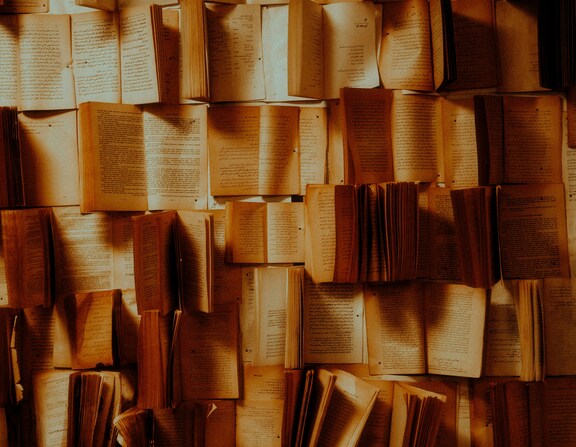
Mohammadreza Charkhgard, Unsplash.
[ A dimly lit salon, somewhere between Bulgakov’s Moscow and the Durrës of my childhood. The Master sits opposite Margarita, holding a cup with the delicacy one uses to hold a book. In the corner, high above, a bust of Goethe nods, as if telling Bulgakov that national literature does not exist. Only the universal. The Master does not object. He listens. As do I. ]
I received my initial education in literature from two women. They exhibited no similarities in appearance or life experiences. One was involved with children and books, while the other engaged with parents and coffee cups. Standing between them was I - a Nature Boy - reminiscent of the figure sung by Nat King Cole in 1948, who, in the aftermath of the War, learned that “the greatest thing you’ll ever learn / Is just to love and be loved in return." During that same year, relations between Tirana and Tito’s Belgrade were severed; consequently, Yugoslav literature was removed from the library. The expulsions began in 1946, when the American and British diplomatic missions departed Albania, marking the start of its isolation from the Western bloc. The Soviet Union filled this void, both physically and within the library. Instead of American and British literature, Bolshevik literature prevailed. During those years, public faith waned; fear overshadowed hope regarding Albania’s future. One pondered how Albanians would behave under complete isolation and whether literature could find an “inner line of escape” to preserve itself from merely serving propaganda or becoming part of the “dogmatic sclerosis” of the “new man." I felt a sense of protection when I contemplated the future. I had Margarita. In those years of imaginative barrenness, she created an invisible refuge for me - a personal mythology that represented the future.
Every culture, in order to protect its imagination from the bureaucratisation of language, creates parallel institutions of knowledge, different from universities and academies. Within them, people try to come to terms with the unknown and make sense of what they cannot explain. Anthropologists called those places “laboratories of meaning,” where society attempts to read the world beyond scientific methods, where tacit knowledge springs from memory, perhaps from a dream, a sign, or a custom, as happened to me in Albania in the 1970s. One of the most trusted institutions of that time was an object. It served as a small archive where, amid the coffee grounds slowly growing cold, I heard what the books did not say. The coffee cup. Margarita D.’s instrument of art. With the patience of a palaeontologist handling a fossil, she would bring the cup close to the light and turn it until, among the remains, the future appeared. I learned that, to read fate, the cup had to be turned upside down, just as Margarita did, even though, by religious heritage, she was Muslim, making the sign of the cross over the cup.
Cultures that confuse the cup with the book are rewarded with both regret and humour. Margarita was part of that regret, too, though she knew that at certain times a person might need both. Had she been born in Britain, she would have been classified as a tasseographer. The English term for such professions sounds so serious that, even when you understand nothing about them, it gives you the impression of an old and respectable craft, completely obscuring the fact that what the person actually deals with is simply coffee grounds.
In Durrës, where I was born, Margarita was called a Fallxhore / Fallxheshë, a term that conjured up the old women of legends about fate. That is why those words seemed too small for Margarita, who could bring into and out of the cup the living and the dead, the imaginary and the real, those we knew and those we would have wished we had never known. How she did it, I do not know, because I saw coffee grounds where Margarita saw book characters, journeys, love letters, joys, sorrows, gifts, fears and mysteries, friends and enemies, births and deaths. Later, when I came to understand that languages have their own ways of concealing and revealing the world, I noticed a small difference. In English, one says “read the cup,” just as one says “read a book.” In Albanian, we “read” a book, whereas we “look at” a cup. Margarita's personal hermeneutics told me that every act of reading is an attempt to see more than what was revealed to us in Albania in the 1970s.
At that time, I also listened to my parents, who spoke of a character in I. Kadare, a certain Hançe Hajdije, who “read fortunes.” Her name echoed as much in literature as in life. As a child, I could not understand where the book ended and the reality of a woman who read the cups of women from the “overthrown bourgeoisie,” as they were called at the time, began - women who came to her looking for a sign, waiting for a word of hope telling them that time might change direction. I imagined them in gloomy rooms, among strands of wool and long silences, knitting sweaters for those who had won history. In my imagination, they resembled sorrowful creatures, like Kafka’s insect, stranded at the edges of the world, far from the centres where decisions were made. Even then, without yet knowing it, I understood that the history of the little man is written not only by the victors, but also by those who weave hopes and survive.
But from my parents I also heard the great history of our time: the Leader, Enver Hoxha, had challenged Khrushchev, striking him in the Kremlin. For a child growing up in a small country on the distant edge of Europe, this sounded like a strange fairy tale: a periphery daring to speak out against the world’s great centres. Perhaps that was where the question that would later accompany me as a writer first began to take shape. Is history always the story of the centre, or can it also be told by those who live far from it?
Margarita did not read the fate of nations. She read the fate of the little man, defenceless before time. They were the same people whom the Polish photographer Zofia Rydet happened to capture in the streets of Durrës. Margarita tried to give form to the everyday anxieties of parents and the dreams of children like me, who, in the age of the bright socialist future, felt at once small and infinite. We grew up in an isolated country, but not an empty one. In silence, through the radio and the few books available to us, songs crossed borders and languages reached us, allowing us to understand that other worlds existed. As I try to construct a chronology, I notice that the song Little Man, sung in English by Sonny & Cher in the year I was born and later, to the same melody, sung by Milva as Piccolo ragazzo in Italian, was not a coincidence, but proof that a person could live in many worlds and in many languages at once. A year later, in 1967, when Albania began its cultural revolution and proclaimed atheism, it seemed that not only churches and mosques were being closed, but also some of the invisible languages through which people spoke to mystery. Although fortune-telling, like religious beliefs, mythologies, and some of the “forbidden books,” would disappear from public life, children continued to dream. Perhaps the desire to write was born precisely in those days. Perhaps it arose from the feeling of being small, born on the periphery, amid so many memories, words and signs, voices and languages, as an attempt to make sense of the world, to connect the centre with the edges.
The other woman who shaped my literary education was my schoolteacher. For her, the classroom was a cup. I never fully understood whether the books she gave me as “required reading” during the summer holidays were a sign of appreciation or a form of punishment directed at me. I read, but the teacher’s books held no mysteries. Nothing forbidden, either. Everything was clear and simple. Virtue was virtue. Vice, vice. The protagonist was rewarded. The antagonist was disgraced. I mocked them. I hated them. In the name of the Albanian people! In the name of international Socialist Realism! A captive between the cup and the book, I chose the cup. It had been made for conjecture; it contained allusions and uncertainties which, as far as the book was concerned, were inaccuracies and flaws. The book showed me the way, like a signpost, but rarely offered me the pleasure of the journey. The cup was rebellious. It was not danger - it was danger itself. I had understood that. Like me, coffee cups had a weakness for the dark world, for criminals and losers, and they did not trust victors. Beneath the enamelled clay or innocent porcelain lay a workshop producing heresy, one that made me believe strong ties existed between the world of crime and the cup. Otherwise, why did we keep them behind the glass doors of the cabinet, like criminals in courtrooms? I wondered. If they were set free, might all the despised, the depraved, the demons and the declassed within them come out? Both favoured negative characters - our antagonists.
Meanwhile, I found the book of Socialist Realism in every corner of the house. And we loved it so much that we fell asleep with a book in our hands, held it against our chests, tucked it under our pillows, without suspecting or fearing that its characters might come out of the pages and terrify us worse than demons. How could that happen when the positive characters were so beautiful, good and well-mannered? There was no warning. On the covers of the books I read in childhood, there were no notices such as: “Reading this book is harmful to your health and that of those around you!” or “Must be 18 or older to consume!” In those conditions of mental drought, taking shelter in Margarita’s coffee cup was an act of self-defence. For this reason, to be honest, I am not a son of the book. I have loved it, I still love it, I have followed it and opposed it, but I do not belong to it. I am a son of the coffee cup. A person like me knows the place he comes from better than the institution that educated him. I remember Margarita D. by name. The woman who taught me, I remember simply as “the teacher.”
Three fundamental principles I learned in childhood were: not to swear, to avoid curses, and to suppress my tears. Literature helped me transform self-control into a virtue. To my peers, speaking calmly seemed like naivety, while hiding one’s tears became the language of strength and character. The only language of rebellion available to me was silence, which lasted until the day when, from the street, I heard the calls for freedom and democracy, the desire to make Albania like Europe, and the slogan “All fellow sufferers! All fellow culprits!” It was the motto of the electoral campaign of March 22, 1992, when the regime's successors relinquished political authority. From perpetrators of verbal violence, they were exposed to insults that, from descriptive words, became social acts, as Judith Butler argues. In the name of national unity and social peace, everyone was asked to avoid “hate speech” against the former winners, who suddenly found themselves a “reversed class” themselves, who might need a Margarita for fortune-telling. Peace, at last. Not only with present reality, but also with imaginary reality, with the characters in books: positive and negative.
Literary theorists refer to the condition in which the potential for evil disappears not because evil is eliminated, but because the language that describes this reality excludes evil from the narrative, as “normative imagination.” But, as Foucault would put it, discourses, besides being tools that name reality, are also “practices that systematically form the objects of which they speak.” A socialist version of Orwellian “Newspeak” was also implemented in Albania, in the books I read during my formative years, with the aim “to make all other modes of thought impossible” and to make every heretical thought “literally unthinkable.”
Through the purging of the vocabulary, which exclusively retained “negative” expressions, it also sought to purge negative thinking about reality. In our lives there were people with vices, but after death, they disappeared because they had not “become literature.” Vocabulary and syntax, therefore, not imagination, created the Albanian reality of a workers’ paradise. And if in the literary paradise there are no crimes, punishments, suffering, and sins, then neither had there been crimes, injustices, or culprits in reality.
The minimisation, to the point of disappearance, of evil from literature transferred Albanian socialist society toward a “discursive paradise”, since discourse, as a practice, does not merely reflect objects but also participates in their formation. In the discursive paradise, language, beyond being merely a means of describing reality, becomes the mechanism that determines what can exist within it. For this discourse, history does not happen, insofar as language and literature erase the possibility of naming certain forms of history. Indeed, even Time itself “becomes human time to the extent that it is organised after the manner of a narrative,” as Paul Ricoeur would put it. Because of “human time,” a day came when the Albanian language of books became so positive that there was no longer room even for curses, which almost disappeared, while swear words, especially those of a religious, magical, and sexual nature, became part of the passive vocabulary. Thus it happened that, within the corpus of the “compulsory books” of my summer reading, history became one-dimensional: political prisons did not exist, despite being full; neither did the camps and villages of internment exist, nor did political torture and killings take place, although they had taken place. They disappeared from memory, because language and literature had erased them from the narrative. The same political-literary strategy also operated upon the little man. Our “ordinaries” - swindlers, adventurers, gamblers, smugglers, prostitutes, traffickers, murderers, the corrupt, thieves, and people with vices - those who lived among us and were found in all literatures, were almost entirely absent from the Albanian literature I read from primary school through university, according to the logic of the “moral hygiene of the text” and “cultural selection.” Thus, Albania had resolved the dilemma that had long troubled European novelists: it had achieved the art of composing narratives without fundamental conflict.
In terms of narrative theory, the process is a form of “narrative optimism,” in which the narrative loses its conflict not by resolving it, but by excluding it from the world it narrates. When the voices, languages, and perspectives that constitute social conflict are excluded from the text, the very space of reality the work articulates also narrows. “The social diversity of speech types,” as Mikhail Bakhtin would formulate it, fails in the literary work because of the absence of coexistence and confrontation among social voices. As a result, heteroglossia also fails, as it did in most works written during Socialist Realism in Albania. These narratives, and others connected to them, continue to live, in other forms, in contemporary Albanian literature of the transition.
Alongside the “normative library” in Albanian, there also existed a “library of banned books,” in Albanian and in foreign languages. These were books written from Independence to Liberation, some by patriotic writers, others by political opponents who, although they used language at a high artistic level, were prohibited from circulating through a Decision of the People’s Court of Tirana, published in the newspaper “Bashkimi” on March 27, 1948, as “harmful to the new society.” From that day on, neither my parents nor I could freely see, touch, or read these books, which, once “banned,” came to be called “yellow books.” Readers instinctively sensed, through their linguistic intuition, that although the “banned books” did not belong to the genres “noir,” “giallo,” or “crime,” they had been criminalised in themselves, since they “do not conform to the new spirit of democracy.” The existence of the “banned books” gave me my first impression that the intervention of power does not remain outside the text, but affects the very mode of its literary existence, its circulation, reading, memory, and, ultimately, its status in literary history.
But, as if to make the situation worse, at that time there also existed a third category: the “library of reserved books.” Each of these books had an - R - on its cover. In the hierarchy, this order of reading imitated the divine scheme in which, on the first floor - the Paradise - were the texts I read; on the second - the literary Purgatory - were the books I could also read, if the authority trusted me; and on the third - the Hell - were books I was not supposed to see. This order created in me the image of a “reader without rights,” who had to be content with the periphery assigned to him and feel good about being at the centre of the periphery. But even a minority of “the favored ones,” who had access to the “exclusive libraries,” did not enjoy the privilege, since they had no one with whom to discuss the “banned books.” Even when, seized by nostalgia, they romanticized the era when communism “also did some good,” they did not exult.
The expansion of narrative freedom after the 1990s brought with it a disorganization of memory and, from there, of imagination and narratives as well. Post-communist Albanian literature, as well as literature in transition, now oscillates between these two inherited paradigms. Within the framework of the “rewriting of history” and the “dismantling of myths,” literary works not infrequently treat the themes of fascism, communism, religion, and the nation as a “literary export product.” From that era, the present inherited two paradigms that continue to this day: the romanticisation of history and the nihilization of reality. The first paradigm asserts that, in dictatorial periods, political punishment existed, but not to the extent that it deserved mention. From here, the path is opened to the process of cancelling reality through language and narrative which, more than aesthetics, produces ideological theses such as that the fascist occupation, beyond being an occupation, brought economic development, united Albania with Kosovo; that colonisation also had positive aspects, such as openness to the West and cultural progress; that communism also did some good, as well as other theses concerning religion and the nation.
The second paradigm, which became clearly visible in Albanian literature after the 1990s, follows the opposite direction, since, from a “narrative of demonisation,” it becomes a “poetics of demonisation.” This perspective strips reality of its nuances, erasing every positive or neutral element, and uses stylistic devices to make the “enemy” devoid of human values, devoid of morality, and representative of all that is evil. Thus, what happens “from the outside” - political control, ideological classification, the division between what is permitted and what is forbidden - returns “from within” in the very way literature constructs the past.
In the scheme of an aestheticised and romanticised literary history, the past is ideally justified, while real conflicts are concealed or neutralised. In literary nihilization, on the other hand, one encounters an extreme de-heroization of history, total doubt toward every other narrative, a reduction of the past to absolute violence or to a meaningless void, which diminishes the nuances in approaching the past and the present, reducing communism to a simple catalogue of crimes and suffering, without its own complexity and, even worse, in a manner resembling the way in which official Albanian historiography of Socialist Realism described the period before 1945. Approaching the issue, Hayden White sees history as the narrative structuring of facts into literary forms, through which history is served to those who learn it only through literature, and helps to understand that both romanticisation and nihilization, besides being two attitudes toward the past, are also two different ways of configuring it in narrative.
Such perspectives within collective memory, in which the past is continually renegotiated to serve the needs of the present, place Albanian literature in crisis because, in both cases, the narrative ceases to narrate and literature becomes a servant, illustrative, and ordered by directive. If we read this crisis according to the relationship of “inside-outside” and “outside-inside,” the problem becomes more complicated, since we are dealing not only with an ideology imposed upon literature from outside, but also with a process through which ideology enters the structures of narrative and, from there, returns as an aesthetic way of organising memory. For the sociology of literature, “inside” and “outside” are positions defined within an ongoing relationship. Beyond being a terrain of facts, the past becomes a field of “semantic warfare” and, as such, also a space in which the legitimacy of narrative is determined. Thus, the struggle to explain the past is simultaneously a struggle to determine which narrative will be heard, which will be silenced, and to which narrative aesthetic and historical authority will be attributed. In the Albanian case, this shifts the focus from the simple question of “what does literature say about the past” to a more complicated question: how has literature produced the meaning of the past and, at the same time, how have institutions, ideologies, and hierarchies of power conditioned the possibility for this literature to be written, read, preserved, and enter collective memory?
Although she spoke in a language different from that of the regime, and although her narratives contained quite a few “negatives,” Margarita was neither imprisoned, nor lynched, nor publicly humiliated. Language protected her. She clothed the truth in figurative speech, without changing its essence or concealing it, shifting it into a “linguistic zone.” George Orwell observed that authoritarian regimes corrupt language, making it impossible to name reality directly. Yet, in the Albanian experience, something else happened. If “Newspeak” sought to narrow thought, “Margarita’s discourse” expanded it through coded language, implication, personifications, and reticence. For Margarita, “illness” was called a “mattress,” the snake-like spiral inside the cup was called “enemy/foe,” the number 7 was good news, the word “theft” was not used, but people spoke of “rodents” in the house. Just as in Victorian novels, scandals also occurred in Albania - extramarital affairs, abortions, rapes - which Margarita summarised all under “troubles.” Her world ended with advice of the kind: “do anything you can so that you don’t end up at the ‘Seven Windows,’” she would tell me, as if she were a British woman talking about the “Seven Seas.” Her “Seven Windows” was not imaginary. In the geography of the Albanian imagination, they were prisons - or archipelagos, as Solzhenitsyn calls them.
Margarita knew the right time for speaking, for silence, and for the things left unsaid about what was forbidden, mysterious, frightening, desirable, intriguing, and anxiety-inducing, which, together with style- the way something was said- was her most striking talent. Because of what she said, what passed through her mind or remained unsaid, I still remember the day when she began to prophesy that not only Albanian literature of that time, but also that which would come afterwards, would never achieve anything comparable to what the “great writer” had already achieved. “Who could this be?” I dared to ask her. She did not answer. She turned her gaze toward the nightstand, where a white plaster bust stood, hollow inside. I saw an image at once concrete and metaphysical: an authoritarian head with an empty gaze. “Enver Hoxha?” I asked Margarita. After a lifetime among words, silences and implications, she knew that the greatest power is not to speak, but to make the other person say for himself what you wanted to say: “You said it!” she replied.
The framework through which the culture of reading, historical memory and Albanian narrative is constructed revealed to me another neglected form of authority: the power that produces knowledge. Thanks to Foucault, the idea has become well known that “power and knowledge directly imply one another,” since control over what is read is not merely control over the circulation of the text, but also over the production of the truth that the text authorises. In this vein, I think of the literature that circulated under the label “for internal use,” where a paradox emerges for anyone who analyses Albanian literature from a typological perspective. This literature, which is said to have failed to produce great antagonistic characters, contradicts this view. Albanian literature indeed failed to leave its successors any great swindler, any monumental obsessive, any metaphysical tempter, any madman, any murderer, any extraordinary slothful man, any envious person, any nymphomaniac, any glutton, any liar of the highest order, let alone any great literary villain, worthy of being inherited as a national treasure, but although the Albanian contribution did not distinguish itself in the literary tradition of human depravity, the blacklist has its gates wide open. Our antagonists were there, but they did not deign to appear in strictly literary books. Political books produced characters more convincing than those aspiring to literary art. And all but one were “negative characters.” The inventory numbers approximately 100 titles. By the same author. Enver Hoxha.
Books such as Reflections on China (1979), The Khrushchevites (1980), Eurocommunism Is Anti-Communism (1980), and The Titoites (1982), TheAnglo-American Threat to Albania (1982) have still not been inventoried as an exclusive literary topos of “antagonistic characters, inhabited by Yugoslavs, Soviets, Chinese and Euro-revisionists from Italy, Spain and France, as well as imperialists in the USA and Great Britain.” Meanwhile, in other books, such as Two Friendly Peoples(1985), Enver Hoxha employs different strategies of creative writing. While praising the ancient traditions of friendship with Albania’s southern neighbours and certain Greek and Albanian-Arvanite leaders of independence, he used memories to distinguish between the Greek people - the “good ones” - and their chauvinist governments - the “bad ones.” Thus, if the European novel generated great and well-known antagonistic characters, Enver Hoxha’s Albanian political prose produced Tito, Khrushchev, Mao Zedong, Deng Xiaoping, and Churchill and Franklin D. Roosevelt.
No antecedent had previously demonstrated a linguistic style as elaborate as that of Enver Hoxha, who depicted Josip Broz Tito as a ludicrous operatic figure, synthesising elements of Balkan aristocracy with Shakespearean intrigue. Hoxha’s characterisation of Khrushchev exudes the vigour of carbon in Goya’s caricatures and attains a chaotic vitality reminiscent of Gogol’s literary achievements. Furthermore, under Hoxha's pen, the Chinese leaders Mao Zedong and his revisionist successors appeared as comic heroes in a saga in which ideology, religion, and pride exchanged disguises. It is exclusively within his writings that one encounters characters embodying such traits, traits absent even in the most esteemed Socialist Realism novels or in Margarita’s cup. These are pure enemies, demons engaged in plotting, ignited by ambition, narcissism, envy, betrayal, lust, cunning, and delusions of grandeur. At this juncture, the concept of the “author function” becomes pertinent, as in Hoxha’s case, the roles of author and power are nearly indistinguishable because, beyond being the individual who composes, he also functions as an entity that organises, delineates, and authorises discourse.
The argument is disputable: his work is political prose, not fiction. Did Enver Hoxha write so much metafiction that he can claim the title of the first avant-gardist of Albanian postmodernism? His entire oeuvre uses memoirs, photographs, notes, letters, spontaneous dialogues, fragments of telegrams, collages and character portraits, with a formal freedom that any genuine postmodernist would have envied? Did he practice intertextuality and pastiche first, even though he banned postmodernism in Albania? His works are so much fiction that, when the notes in the factual protocols were compared with what Hoxha had written, the fictionality was evident. He even deserved to be the first and only Albanian dissident because, paradoxically, he was the authority who appropriated the forms of liberation from authority. The destabilisation of the authoritarian voice, which should have come from censored writers, in this case developed from the centre of power.
But Hoxha was unsurpassed in quantity as well. While he was alive, no Albanian writer matched that admirable rate of production. A new book every year. Numerous publications. Translations into fifteen languages. Enver Hoxha was not simply a writer. He was a literary industry. The narrative seems grotesque - but Hoxha was grotesque. The grotesque is charismatic when it is in power. Hoxha accomplished everything professional Albanian literary fiction aspired to and failed to achieve. And, despite the absence of an exact record of print runs, the approximate number of Hoxha’s publications, in Albanian and foreign languages, is estimated at tens of millions of copies, also published in foreign languages in Albania, by “8 Nëntori” in Tirana. We must admit, at some point, the injustice that has been done to him. Besides being our demiurge, the creator of themes, the inspiration for ideas and grand scenes for epic novels and polyphonic poems inspired by his thought, Enver Hoxha’s literary legacy, if it does not overturn the hierarchy, shakes it. And why should he not have claimed that, while he was alive, he was the most famous and most translated writer, not only among politicians, but among writers themselves? Why not? After all, Churchill - an anti-fascist, unlike Hoxha -did he not receive the Nobel Prize in Literature in 1953? Hoxha was modest. He would have accepted even the title of founder of the literary school of dictators. Muammar Gaddafi, with a few short stories, was considered an important author. Saddam Hussein and Saparmurat Niyazov of Turkmenistan were, too. Hoxha had an Opera Omnia behind him. Ars longa, Enver! He is neither water (H₂O), nor hydrogen (H₂). He is an atom. He is everywhere. In every silence. In every memory. After the statue fell, his creative writing courses remained within us.
Beyond irony, totalitarianism imparted to the Albanian transition not only fragile political institutions and an economy in critical condition but also a culture characterized by political domination over art. Within this cultural backdrop, the production of antagonism in literature and the exoticization of literary works persist as fundamental narrative mechanisms even in contemporary times. According to Pierre Bourdieu, these elements can be interpreted as an intricate intertwining of political power with symbolic capital, rendering it comprehensible that “the symbolic capital is nothing other than economic or cultural capital when it is known and recognised,” thereby transforming power into an authority that is symbolically acknowledged and legitimized.
The cult of the individual - which transformed Enver Hoxha into the central figure of cultural thought and cast him as the author of the broadest literary corpus ever published in Albanian - also helped shape the collective imagination around the necessity of the “central author.” An examination from within of this scene reveals a further cultural, literary, and epistemological problem that continues as well today: the paradox of authority with power, presented as literary authority, a model that, in more minor and subordinate forms, was applied to every author who possessed even a small degree of bureaucratic or literary power and which, in today’s terms, is transferred toward authors with political, media, economic, or diplomatic power. Under Foucault’s reading, both yesterday and today, whether viewed from outside or from within, the phenomenon is a form of power that simultaneously produces both the authority and the truth that legitimises it. From this, it becomes clear that authority is not limited to imposing a norm; it requires producing truth that makes the norm acceptable, expressing that “we are subject to the production of truth through power and we cannot exercise power except through the production of truth”.
Hoxha was convinced that his ambition to occupy the position of honour was justified when the writers themselves acknowledged his literary authority, referred to him, authored books in accordance with his postulates, and published their works after he had articulated the corresponding theses in books, speeches, or his own writings, thus rendering the writers’ works as literary illustrations of Hoxha’s theses. In this context, further and more comprehensive research, extending beyond this text and based on a comparative analysis of Enver Hoxha’s writings and those of some of the most renowned Albanian authors of the period, would elucidate the distinctive relationship between absolute political power, national and universal literature, and popular-oriented literature during the era of Socialist Realism in Albania. Such an analysis would elucidate the functioning of the literary system at its three primary levels: authorial propaganda (Hoxha), artistic creativity (Kadare), and organic and institutional poetry/prose (Agolli). As authors active during the same period, their themes coincide and intersect; in some instances, to the point of symmetry, and despite being articulated from different perspectives, they converge around the National Liberation War, the relationship between East and West (isolation), the myth of origins, the myth of David (symbolizing the heroic resistance of the small against the great), or the myth of Prometheus (symbolizing self-sacrifice for the pursuit of ideals).
Their positions toward the internal and external reader also differ, since Hoxha’s publications circulated through “institutional obligation,” Kadare’s were experienced as “cryptograms,” while Agolli functioned as the “conscience of a generation.” In other words, it may be said that Enver Hoxha wrote “to control the present and history,” Kadare wrote to “escape the present through history and universality,” while Agolli wrote “to humanise the present.”
But beyond the culture of political domination over art, the transition also inherited from that era a tendency not to see reality through the complexity of human relationships, but through an ideological prism. It can be observed that the politicisation of literature continues even in contemporary writing, where the value of a literary work is measured not through its aesthetic autonomy, but through the usefulness attributed to it in relation to the nation and society. This literature continues to struggle to break away from the “ideo-aesthetic model,” which overvalues the “dominant theme” and the “principal writer.” Such models continue to reduce the writer to an instrument of a doctrinal or dogmatic cause, in which he is regarded as an ideological authority.
Equally persistent is the inherited confusion surrounding texts situated somewhere between history, propaganda, and literature. The very fact that, even today, the boundaries between historical fact and literary fiction remain as unclear as they once were suggests that the same culture of domination continues to be lived within. The legacy of totalizing aesthetics, through naivety or pragmatism, also shapes how Albanian literature of the transition approaches the past, in which memories are presented as history proper, causing its relationship with ideology to undermine literary autonomy and literary values. In this sense, ideology, without being reduced to an external doctrine, encompasses “modes of feeling, valuing, perceiving and believing,” as Terry Eagleton would define it. These elements are connected with the maintenance and reproduction of social power, through which a text is read and evaluated.
The issue would be troubling if former models were not discernible in contemporary literature, making the inverted model of Socialist Realism operative, since the problem connects the legacy to the continuity of structures that may produce new forms of authoritarianism. Socialist Realism is unlikely to return as an aesthetic program but, beyond the identical return of a regime, attention turns to reproducing the conditions that make the reappearance of contemporary Albanian literature as ideological art possible, offered through ready-made narratives.
While the previous century was characterised by narratives such as “what is permitted to be written?”, the current century focuses on “what is being said and heard about us?” In this respect, the value and legitimacy of a work are no longer determined solely by the text, but by the relationships among authors, critics, publishers, institutions, and different forms of symbolic capital. From a dual perspective, internal and external at the same time, contemporary Albanian literature could also focus on issues such as authorial hierarchies and the relationship between centres and peripheries. Theoretically, it can be observed that the international literary space is organised through unequal relations between centres and peripheries, where “each writer’s position must necessarily be a double one,” a position that is simultaneously national and international, as Pascale Casanova observes.
In this regard, it can be observed that Albanian literature produces more texts than ever before, while its authority - the authority of the author and of the book, as cultural entities - continually diminishes. The perception of the Albanian writer is also changing once again. He is no longer the “national prophet” of the Romantic model, nor the didact of Socialist Realism, but something strange and more modern: an administrator of fragmented collective memory, a translator between worlds, a specialist in nuances in an age that rewards noise and fleeting attention. We can also see that, instead of a single literary centre and a single authorial centre of the past, we now have a series of islands with voices from Tirana to Pristina, from Skopje to the diaspora, including universities and established social networks. The writer is an “administrator of memory,” but memory is not simply an individual repository, since it is reconstructed within the “social frameworks of memory” and, referring to Maurice Halbwachs, “the individual calls recollections to mind by relying on the frameworks of social memory”.
With the death of Ismail Kadare, an era came to an end not only because Albania’s best-known author ceased to write, but also because, with his departure, the concept of the “last national writer,” capable of encompassing at once the history, language, narrative, and imagination of an entire nation, diminishes. While his works continue to serve as the most prominent entry point through which Albanian literature has gained recognition, other authors, from Albania, Kosovo, and the diaspora, are gradually expanding this landscape. After Kadare, Albanian literature resembles less a cathedral and more a city. Undoubtedly, more chaotic, but also more inclusive, perhaps less monumental, but more alive than ever and in the process of reshaping itself. Translation may indicate the future. Albanian literature is expected to be less isolated, but increasingly dependent on translators rather than literary critics. Nevertheless, translation, without being considered a channel of international circulation, is also seen as a mechanism that shapes the work's position and function, shifting the process from translation as reproduction to translation as a cultural fact in the receiving system.
It is no coincidence that literary institutions - despite their continuing difficulties - are trying to allocate more resources to translation and translators. The second indicator would be the diaspora. A considerable part of future Albanian literary works may not necessarily be written within Albania or Kosovo. They are being written in Berlin, New York, London, Bucharest, Milan, Helsinki, or in any other city, large or small, where a good writer lives. Moreover, they have been written for decades not only in Albanian, but also in other languages. Meanwhile, their writers, especially the diaspora in the same literary field, do not have to coincide with the nation's territorial boundaries, since the writer’s position is simultaneously national and international.
The third indicator would be technology. For the first time in its history, the Albanian language is becoming global without actually being global. It has entered the sphere of digital corpora, computational language processing, and artificial intelligence. Historically, every major literary revolution has originated in a technical revolution: the printing press, the newspaper, the serialised novel, and the mass-market book. Consequently, there is no reason to believe that the algorithm will be the sole exception capable of challenging Albanian literature. The transition of Albanian into digital corpora and artificial - intelligence environments is not merely a technical expansion of literature, but potentially a transformation of its cultural environment. Nevertheless, the most credible prediction is perhaps also the simplest. Albanian literature will continue to seek what it has always sought: original ways of coexisting with uncertainty and a more accomplished aesthetic, as during its golden years, a century ago, when Poradeci, Kuteli, and Koliqi wrote poetry and prose of high artistic achievement. The Republic of Albanian Letters, like every small republic with great ambitions, lives by the same old belief: when the world leaves a trace, there will be someone to write it down and another to read it. On one condition: that it be well written.
Does the mother tongue serve merely as a container of memory, identity, and experience, or can language itself become a formative force? What are the implications when translation or writing in a foreign language functions not simply as a formal or promotional instrument, but as a means of literary formation and circulation? Historically, Albanian literature has shared the aspirations that sustained other European traditions: the ambition to participate in the broad exchange of ideas, texts, and prestige commonly known as the Republic of Letters. Contemporary efforts to increase the visibility of Albanian literature on the global stage therefore do not constitute a new departure, but continue a centuries-old tradition of mediation, translation, and cultural exchange.
One of the earliest examples of this tendency is the case of the Albanian humanist Marin Barleti (1450/1460–1512/1513). Historia de vita et gestis Scanderbegi, Epirotarum Principis, published at the beginning of the sixteenth century, did not remain confined to the space in which it was conceived. It quickly crossed linguistic and cultural boundaries, being translated into French, English, and German. Its itinerary demonstrates that the path from what we usually call the margins toward centres of cultural legitimacy has never been entirely closed. There has therefore always existed a corridor - narrow and selective - through which literary works gained acceptance by virtue of their merit, but also through mastery of a decisive instrument: a language with international circulation. Barleti’s History of Scanderbeg was written in Latin. In Pascale Casanova’s model of the World Republic of Letters, languages and literatures, without being positioned on an equal footing, circulate according to different degrees of symbolic capital and international circulation.
Albanian literary history offers several examples of a model in which literature is structured as a competitive international space, in which high-prestige languages function as carriers of literary capital. In addition to Albanian, Naim Frashëri wrote literature also in Greek, French, and Persian; Pashko Vasa wrote a novel in French; Sami Frashëri wrote his play in Turkish; Engjëll Mashi published his scholarly work on the origins, customs, and condition of the Albanian nation in Italian and French; Fan Noli wrote texts in English; Mit’hat Frashëri and Faik Konica in French. These cases demonstrate that international circulation, which today is pursued with such insistence and proclaimed as a novelty, has not been a fortuitous aspiration, but a permanent component of Albanian cultural history.
Another example comes from the nineteenth century, when the relationship produced an episode of particular symbolic significance. Alphonse de Lamartine, the great poet of French Romanticism, a prestigious figure of European culture of his time, read the poetry of the Albanian-Arbëresh writer of the diaspora in Italy, Jeronim De Rada, and wrote the words that have since become part of literary memory: “Poetry came from your shores and must return there.” At first sight, this may be perceived as an act of courtesy within the community of poets. However, from Pierre Bourdieu’s perspective, the act constitutes an example of the transfer of symbolic capital. When a renowned author supports a writer who occupies a more peripheral position within the European literary field, central authority enters into dialogue with the margins. The case of De Rada illustrates the fact that recognition by established literary authority increases the visibility of value, mediated through a connecting bridge-language.
Institutions that focus on Albanian literature must be prepared to acknowledge that translation is simultaneously a bridge and evidence of an imbalance. Without translation, this “minor literature” remains almost invisible, but also is absent from the actual itineraries of travellers, unable to become part of what David Damrosch calls “the movement of literature across languages and cultures.” Yet, when translated, the same literary corpus confronts a familiar paradox. It gains visibility but may no longer be perceived directly, because after translation, it is examined through the perspectives of those who have presented it on stage. Its voice is filtered through the sensibilities, expectations, and interpretive frameworks of mediators—the translators, publishers, and foreign critics.
Contemporary Albanian literature is no exception to this principle, which governs global circulation across unequal literary spaces, because cultural peripheries are not static categories: yesterday’s periphery may become tomorrow’s centre. It is enough to observe the changing geography of literary attention over the last few decades, when the Nobel Prize has periodically shifted attention toward the “peripheries,” to understand that, during certain periods, authors from these countries have shifted the central axis of the European literary landscape. Yet this does not mean that the literary universe is free from relations of power. Paris, London, and New York, besides being places where literature is published, are also symbolic observatories from which the coordinates of literary prestige are determined, since decisions are made there about what deserves to be called “universal” and what remains confined to the less desirable status of the “provincial.”
This mechanism, examined by various postcolonial theories, including Edward Said and Graham Huggan, argues that peripheral literatures are often read as documents of identity or ethnography, while their formal and aesthetic complexity is relegated to a secondary position. Albanian literature is no exception. It shares the fate of many traditions that come from the margins of the literary map, as “minor literatures,” which Deleuze and Guattari conceive as essentially political forms, in which the individual voice tends to become a collective voice, often not as an aesthetic choice but as a consequence of the author’s and his language’s marginal position. Albanian literature, particularly during Romanticism and Socialist Realism, demonstrates this strong interweaving between individual expression and collective and ideological function. In Itamar Even-Zohar’s terms, all of this can be seen as part of a peripheral literary polysystem, where ideological function limits aesthetic autonomy.
A problem also arises with the danger of a monocentric model, in which one author becomes representative of an entire literary space. Conversely, the coexistence of voices and perspectives creates a more plural system, in which literary authority is produced through dialogue and competition among viewpoints. In this sense, David Damrosch’s idea of world literature is essential: a work becomes part of it not merely because of its national origin, but when it enters intercultural circulation and acquires new meanings in different contexts of reading.
This circulation, however, is not spontaneous. In the Global Republic of Letters, works do not circulate solely on aesthetic merit, but through a network of actors and institutions that administer symbolic capital. To a large extent, they determine which works cross borders and which remain confined to the space of their origin. Therefore, the same text may acquire different values and meanings according to the cultural system into which it enters. Consequently, not only the text but also the writer is treated primarily as a witness to history. Such an approach favours the creation of the figure of the “central author,” in which one writer disproportionately represents an entire tradition. As Pascale Casanova warns, rather than being perceived in their complexity, peripheral literatures risk being reduced to a few isolated figures.
Albanian literature has produced only a limited number of authors who have been repeatedly translated, mainly into French, German, and Italian, while its penetration into English, Spanish, Polish, Romanian, and other languages has been slower and more uneven. The case of Kadare is paradigmatic. For many international readers, he has become the principal gateway to Albanian literature and culture. His works have functioned as a cultural map of Albanian history, myths, and political traumas and have made visible the experience of a peripheral country within the European literary consciousness. Yet precisely the success of this model of representation has produced a paradox: the way Albanian literature has been represented abroad and the way it has been hierarchised within the country have mutually reinforced one another, making its actual diversity less visible.
The case of Fatos Kongoli interprets this mechanism in a significant way. Although he was translated and well received by critics in France, he was often defined as “another K.,” that is, through an interpretive model already established by the figure of Kadare. This raises the question of the capacity of critical categories produced in cultural centres to interpret minor, diasporic, and migratory literatures, especially those created in languages with limited circulation. From Goethe’s warning in 1827 about the advent of the “age of world literature” to the present, beyond the ways in which a national literature enters the world, the question also arises as to who determines the conditions, categories, and modes of reading through which it enters it. Therefore, contemporary Albanian literature should be viewed not as an exception, but as an example of a widespread phenomenon: more than by their dimensions, minor literatures are also defined by the ways in which they are classified, mediated, and made visible within the world system.
The fundamental question remains: who should give voice to a minor literature when cultural institutions either leave it outside circulation or include it only through their own critical and institutional filters? Viewed from outside, Albanian literature has often been interpreted more as a historical, political, or anthropological document than as an autonomous aesthetic form. This reduction is connected to the way the horizon of expectations functions. Before entering the text, the international reader perceives it through a repertoire formed by media, institutional, and cultural discourses about Albania. Thus, the work is expected to offer “the Albanian experience” rather than what the work produces through its language, form, perspective, and aesthetics. The text is read through its heteronomy - its relationship with history, politics, and society - at the expense of its aesthetic autonomy. This creates a paradox, since liberation from the ideological utilitarianism inherited from Socialist Realism may be replaced by a new, documentary or exotic utilitarianism, driven by market dictates. If before the political changes the work was legitimised by its ideological function, it is now legitimised by its ability to testify to the “uniqueness” of Albanian themes. The regime of legitimation indeed changes, but the heteronomous structure remains, since Albanian literature is valued more for what it represents or serves than for the autonomous way it produces meaning.
At this point, the “uniqueness” of the subject matter, instead of rewarding, punishes, since it becomes a mechanism for producing the Other. In its eyes, Albanian reality appears as a border space - between East and West, Europe and the Balkans, modernity and tradition - and literature becomes an instrument for confirming this position. The trauma of dictatorship, corruption, emigration, the bunker, the Kanun, Besa, blood feud, or other identifiable figures are not problems in themselves. They become problematic when they are transformed into preconditions of international readability. Then, a real repertoire of experiences becomes a compulsory repertoire of representation. This is the gentlest form of what may be called “thematic colonisation,” which is not direct control over literary production, but influence over what is considered worthy of being translated, published, and circulated. For peripheral literatures, this means that entry into global circulation depends, just as much as on aesthetic value, on a work’s ability to adapt to the categories that the dominant literary institutions recognise as standard.
Contemporary Albanian literature is not peripheral because it lacks aesthetic quality, but because it has more limited access to the institutions that produce visibility and symbolic capital, while it itself also does little to institutionally standardise the criteria of representation. In this respect, translation becomes decisive for this literature because, beyond the formal and neutral transfer of the text, it is an act of interpretation, mediation, and legitimation. Universality, far from being a quality that operates automatically beyond language, becomes an effect of circulation, produced by translators, publishers, critics, institutions, and cultural networks.
Nevertheless, the relationship between margins and established cultural centres need not be conceived solely as dependence, since a peripheral position may also produce an advantage. The mechanisms through which dominant institutions construct their universality become more visible from outside them. The literature of the Albanian diaspora and writing between languages materialise this potential by shifting the “Albanian subject matter” from the object of an external gaze into a multiple subject of experience. In this sense, the diaspora, beyond the expansion of the geographical space of Albanian literature, is transformed into an expansion of its epistemic space. Here, Bakhtin’s concept of polyphony becomes an essential interpretive framework, since it explains how a polycentric literature allows the coexistence of autonomous consciousnesses, perspectives, and positions that are not reduced to a single synthesis, without being organised around a single voice that determines the meaning of national experience, including its subject matter. Rather than Albania and “Albanian subject matter” being produced as a single object of representation, it appears as a space of voices, experiences, and positions that are not fully compatible with one another. Precisely this plurality may liberate Albanian literature from the obligation to “explain Albania.”
This perspective shifts this literature away from the “status of the thematics of trauma.” The history of dictatorship and transition remains material for written memory, but not necessarily the universal key to interpreting contemporary Albanian literature. The problem is not the presence of history, but its supremacy over form. Aesthetic autonomy requires transforming history into the material of imagination, rather than subordinating imagination to a prior historical function.
Such an approach shifts the issue toward universality. Without suggesting that the literary work be stripped of its national specificity or adapted to the expectations of the centre, universality requires specificity to become universal through aesthetic transformation into a communicable experience. The less literature attempts to “represent Albania” and the more it articulates aesthetically, through its concrete material, the problems of belonging, memory, displacement, language, loss, desire, and uncertainty, the more naturally it enters into dialogue with other experiences. Likewise, internationalisation, in the case of this literature, need not imply adaptation to the horizon of expectations of the centre, but the ability to expand that horizon. The aesthetic emancipation of Albanian literature will consist in moving from literature expected to testify, represent, or exoticise, toward literature that gains the right to remain undetermined by its extraliterary function. If a literary periphery seeks only to enter the centre, it automatically and unquestioningly accepts the hierarchy of the system and, along with it, its peripheral status. If, by contrast, this literature enters circulation while preserving the autonomy of form, bringing a plurality of voices and diverse subject matter, it may contribute to the polycentrisation of itself and of the global literary space, including its emergence from the peripheral zone.
Arian Leka
Bibliography:
Bakhtin, Mikhail. Problems of Dostoevsky’s Poetics, University of Minnesota Press, 1984.
Bakhtin, Mikhail. Discourse in the Novel, University of Texas Press, 1981.
Butler, Judith. Excitable Speech: A Politics of the Performative , Routledge, 1997.
Barthes, Roland. Image, Music, Text. Hill and Wang, 1977.
Bourdieu, Pierre. Language and Symbolic Power. Harvard University Press, 1991.
Casanova, Pascale. The World Republic of Letters. Harvard University Press, 2004.
Damrosch, David. What Is World Literature? Princeton University Press, 2003
Derrida, Jacques. Of Grammatology. Johns Hopkins University Press, 1976.
Eagleton, Terry. The Ideology of the Aesthetic. Oxford: Basil Blackwell, 1990
Even-Z. Itamar. The Position of Translated Literature within the Literary Polysystem.”Polysystem Studies, 1990
Foucault, Michel. “What Is an Author?”, in Language, Cornell University Press, 1977.
Foucault, Michel. The Archaeology of Knowledge, Pantheon Books, 1972.
Gilles Deleuze & Félix Guattar. Kafka: Toward a Minor Literature, University of Minnesota Press, 1986.
Graham Huggan, The Postcolonial Exotic: Marketing the Margins, Routledge, 2001.
Halbwachs, Maurice, On Collective Memory, The University of Chicago Press, 1992.
Orwell, George. Nineteen Eighty-Four, The Principles of Newspeak, Secker & Warburg, 1949.
Ricoeur, Paul, Time and Narrative, The University of Chicago Press, V-I-III, 1984-1988.
Said, Edward W. Culture and Imperialism. Alfred A. Knopf, 1993.
